Faculty Speakers
Dr. Kathryn Bryant
 Dr. Kathryn Bryant is an Arizona native who got her Ph.D. in low-dimensional topology from Bryn Mawr College in 2016. After teaching math for a year at Colorado College, she transitioned out of academia and into industry, where she has worked as a data scientist ever since. Throughout her data science career, she has gained expertise in machine learning, in statistics for experimentation (A/B testing), and in causal inference, and she has recently been learning how to leverage LLMs for both business and personal use. In her free time, she writes novels, plays volleyball, and hangs out with her cats.
Title: The Math of AI Hallucinations
Abstract: Large language models (LLMs) like ChatGPT and Claude generate fluent, convincing text—and sometimes get things completely wrong. This talk explores the mathematical machinery that makes such hallucinations not just possible but (so far) inevitable. Starting from the basics of tokenization and conditional probability, we build up to embeddings, cosine similarity, and the attention mechanism. We then examine how intrinsic, extrinsic, and factual hallucinations arise as natural consequences of the model architecture and reward function. Finally, we discuss how a data scientist who uses LLM’s in professional applications might quantify a model’s tendency to hallucinate. The talk is aimed at undergraduate math majors and assumes familiarity with linear algebra and basic probability.
Dr. Kurt Herzinger
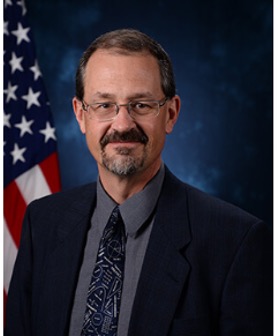 Kurt Herzinger received his bachelor’s degree, master’s degree, and Ph.D. in mathematics from the University of Nebraska – Lincoln. His graduate research was in commutative algebra with connections to numerical semigroup theory. He earned his Ph.D. in 1996 and began work as an assistant professor of mathematics at West Texas A&M University. In 1998, he took a position as an assistant professor at the United States Air Force Academy in Colorado Springs. He was promoted to associate professor in 2001 and to full professor in 2006. His research interests include problems in numerical semigoups and two-player combinatorial games. He also dabbles in ancient Diophantine approximation techniques such as Greek ladders and continued fractions.
Title: My Journey from Numerical Semigroups to Combinatorial Games
Abstract: A numerical semigroup S is a submonoid of the non-negative integers with finite complement. Problems related to numerical semigroups, including the famous Frobenius problem, have been studied for decades. In this talk we will not examine numerical semigroups in detail but rather examine how my study of these structures led me to examine three different, but related, two-player combinatorial games including Conway’s game of Sylver Coinage, a new game called Destroy the Graph, and a variation on the game of Nim. We will examine how these games are played, what is known about winning and losing positions, and offer some opportunities for undergraduate research. We’ll also play some games during the presentation.
Dr. Hiram Beltrán-Sánchez
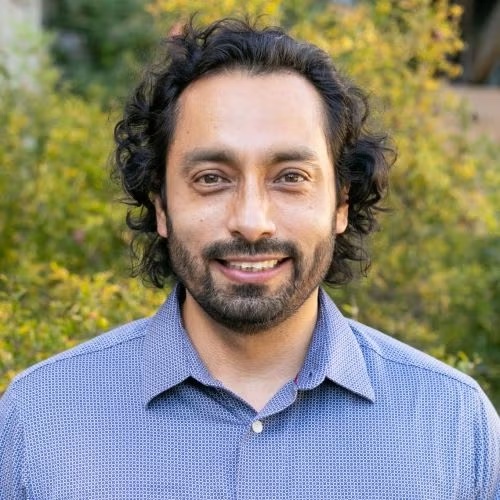 Hiram Beltrán-Sánchez received his bachelor's degree from the National Autonomous University of Mexico, a Master in Mathematics from NAU, and a Master's and PhD in Demography from the University of Pennsylvania. He was a postdoctoral researcher at the University of Southern California, a research fellow at Center for Population and Development Studies at Harvard University, research associate at the University of Wisconsin-Madison, an a visiting professor at Harvard University in 2024. His is currently a Full Professor in the School of Public Health and the Sociology Department at UCLA, he is also Associate Director of the UCLA California Center for Population Research (CCPR) and co-director of USC/UCLA Center on Biodemography and Population Health. His research interests include the demography of health and aging, particularly mathematical demography and its application to modelling and understanding human survival.
Title: Implausibility of Radical Life Extension in Humans in the 21st Century
Abstract: The dramatic increase in global life expectancy observed over the 19th and 20th centuries has slowed considerably in the last three decades. Despite accelerated advances in medicine and public health, life expectancy at birth in the world’s longest living populations has only increased an average of 6 ½ years since 1990. Recent empirical evidence suggests that humans are approaching a biologically based limit to life and that the most impactful progress on longevity from medical breakthroughs have already occurred. Modern medicine is yielding incrementally smaller improvements in longevity even though medical advances are occurring at breakneck speed. In this presentation I'll show some data suggesting that since 1990, improvements overall in life expectancy have decelerated. This analysis also revealed that resistance to improvements in life expectancy increased while lifespan inequality declined and mortality compression occurred. Our analysis suggests that survival to age 100 years is unlikely to exceed 15% for females and 5% for males, altogether suggesting that, unless the processes of biological aging can be markedly slowed, radical human life extension is implausible in this century.