Mathematics & Statistics Seminars
Northern Arizona University
Math on Tap
Come join us for Math on Tap! The event is meant to be appealing and accessible to a wide range of people. Everyone is welcome. Bring your friends, significant others, neighbors!
Math on Tap takes place on the first Wednesday of every month (during the academic year) at 6PM at Mother Road Brewery. Mother Road Brewery is a restaurant, so 21+ is NOT required. Please come join us!!
For those of you unfamiliar with “on Tap” events, Math on Tap is a variation of events that often go by the name “Science on Tap” or “STEM on Tap”. These events run at various cities around the country. In Flagstaff, we have Astronomy on Tap (sponsored by Lowell Observatory), Science on Tap, and Ales with the Arb (sponsored by The Arboretum at Flagstaff). And now Math on Tap!
The format will vary from event to event, but typically there will be a 30-minute talk aimed at a general audience followed by a short informal interview. During the event, people are welcome to eat and drink (this is encouraged!).
Schedule Fall 2026
Note that talks are listed in reverse chronological order.
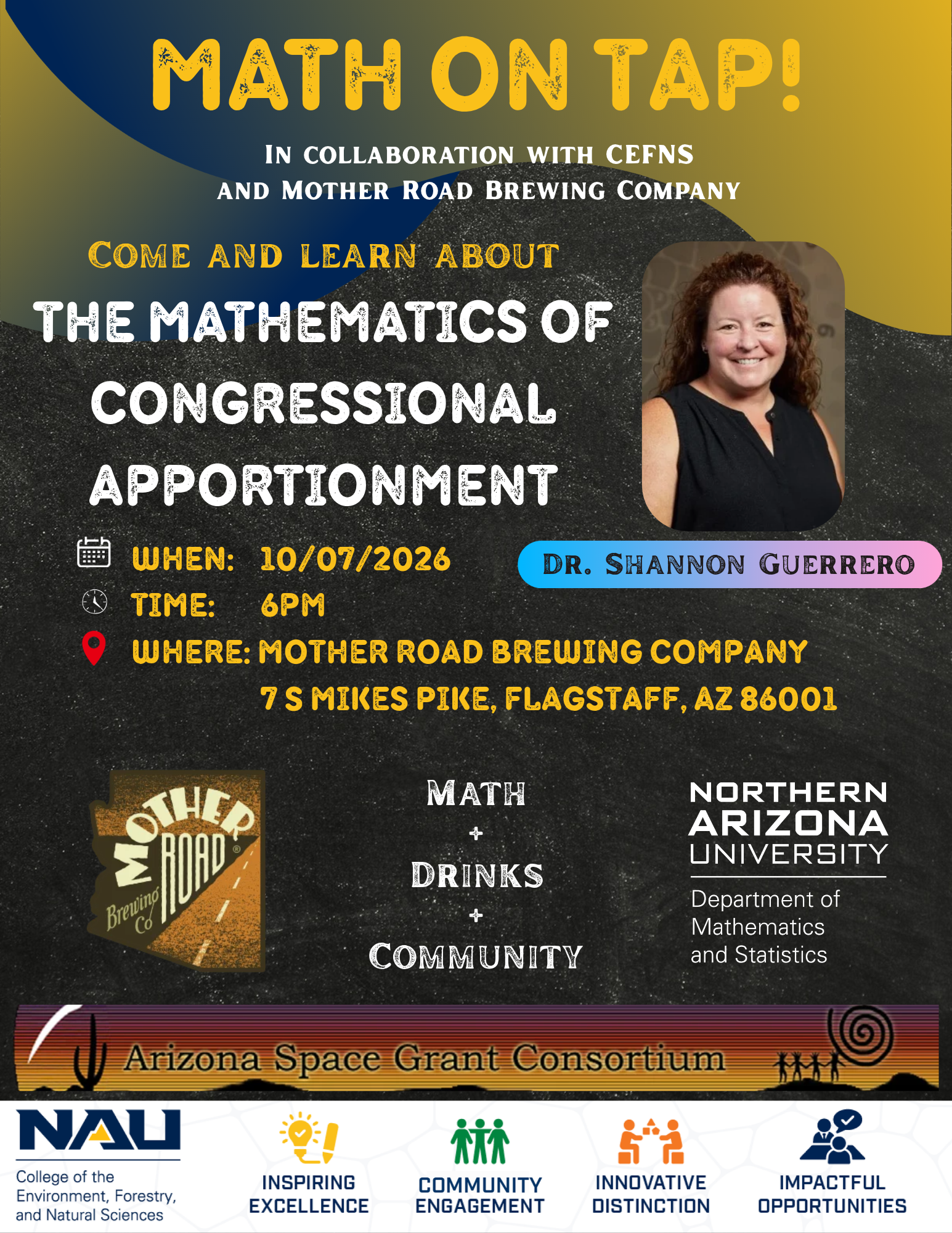
The Mathematics of Congressional Apportionment
Date: October 7, 2026
Speaker: Shannon Guerrero (NAU)
Abstract: The Congressional Apportionment Problem is one of the oldest and most persistent mathematical challenges in American democracy: how to fairly divide a fixed number of political seats among states with constantly changing populations. While the U.S. Constitution requires that seats in the House of Representatives be distributed based on population, achieving perfect fairness is mathematically impossible. Over the past two centuries, this dilemma has sparked fierce debates among founding fathers like Thomas Jefferson and Alexander Hamilton, leading to different mathematical formulas that favor either larger or smaller states. The talk will provide a brief history of the methods used and considered for its solution, along with the pitfalls of each.
“…no political problem is less susceptible of a precise solution than that which relates to the number most convenient for a representative legislature…” - James Madison, The Federalist 55
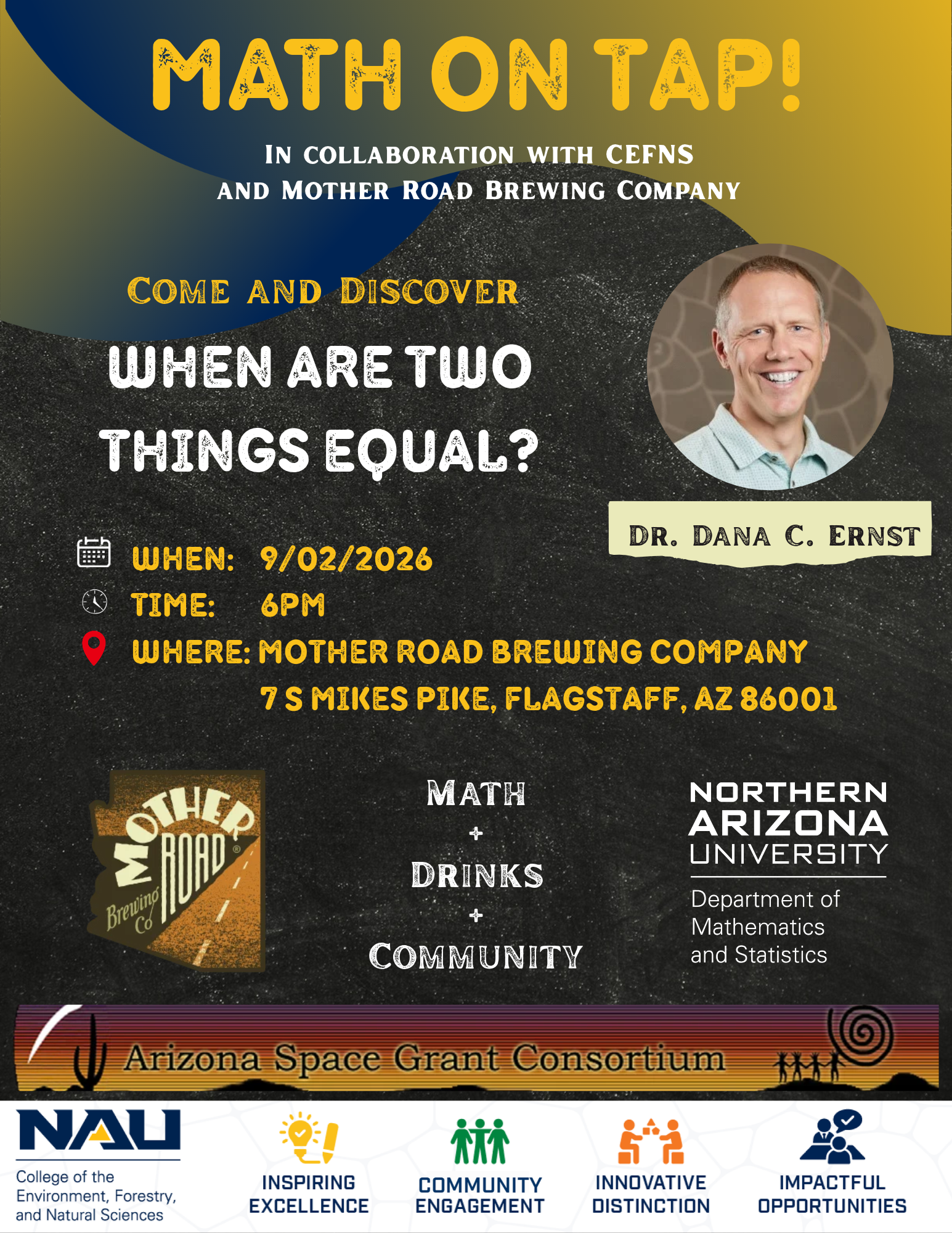
When are two things equal?
Date: September 2, 2026
Speaker: Dana Ernst (NAU)
Abstract: When are two things equal? This question is much more interesting than it might seem. Two objects can look different but behave in exactly the same way, while two things that look identical may differ in ways that matter. Through a collection of playful examples, we will explore how the meaning of ``equal’’ changes with context. Along the way, we will encounter one of mathematics’ most useful ideas: sometimes two things should be considered the same not because they are identical, but because they have the same underlying structure. No mathematical background is needed, just a willingness to reconsider what it means for two things to be equal.